
In today’s era of cultural and political confusion, metaphors can sometimes help clarify complex situations. In this article, we use the classic story of Don Quixote to highlight US foreign policy under President George W. Bush.
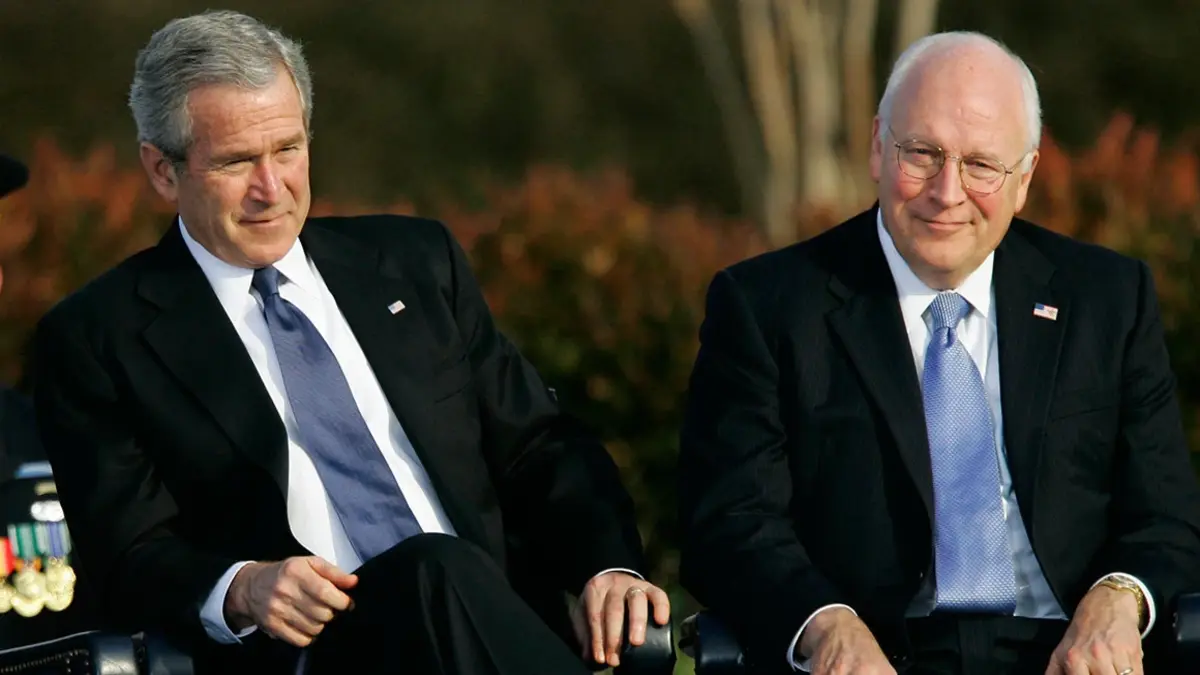
George W. Bush, like Don Quixote, had a grand mission with his Vice President, Dick Cheney (a Sancho Panza). In their fight against the “war on terror,” they confronted “windmills” in the Iraqi desert, which they believed to be dangerous giants—weapons of mass destruction.
Iraqi Windmills
George W. Quixote told his deputy:
“Those are giants, and I will fight them for the truth and the will of God.”
Dick Sancho tried to explain that what they saw were actually windmills. But George W. Quixote refused, viewing them all as threats that must be destroyed. With the authority of President and Vice President, they brought in a large military force to subdue these “giants.”
Good and Bad
It is true that Saddam Hussein killed many Iraqis. However, the American military effort also caused significant civilian casualties in its quest to “provide freedom.”
While the government may consider the number of casualties reasonable, the moral question remains: how many are too many?
This has not stopped the violence in Iraq; the atrocities persist and grow. While much good has been done for the Iraqi people, there is also much tension and anger brewing in the land that is not yet fully understood.
A Contradiction
As supporters of conservatism and republicanism, we recognize the following:
- The President and Vice President once committed to using the military to win wars.
- However, they made significant flip-flops, embroiling the country in complex and uncertain conflicts.
Many observers have called for a reassessment of the effectiveness of this policy, including Patrick Buchanan, who wrote in The American Conservative (March 2004) that a second Bush term would likely not lead to new wars.
Strategic and Rhetorical Weaknesses
- American forces are limited and spread thin.
- Tensions are emerging within the regular military, reserves, and National Guard.
- The “axis of evil” rhetoric has been toned down, but the threat remains.
- Considering war against Libya, Syria, or Saudi Arabia, it would weaken relations with allies, strain the military, and raise the possibility of re-enlistment.
Thus, many are asking: does this military policy truly make America safer from terrorism?
Kerry and Bush’s Similarities in Iraq
Mort Kondracke noted a common ground between Democratic Senator John Kerry and George W. Bush administration:
- Kerry wanted America to “stay the course” in Iraq, while criticizing Bush’s policies as “stubborn” and “arrogant.”
- Kerry emphasized the importance of national security without vetoing others, and viewed terrorism as a serious challenge that must be met with force if necessary.
This demonstrates that although Kerry comes from the opposition, he is not fundamentally opposed to national security or American involvement in Iraq.
A Choice for Conservatives
Conservatives face a crucial decision:
- To maintain the Bush administration, with its promises of fiscal responsibility and social conservatism, hoping Buchanan is right.
- To elect a new President (Kerry), who is believed to be more cautious and reluctant to use military force to solve all the world’s problems.
The Constitution grants the right to choose, and this decision must consider whether America’s morals and strategy align with the principle of “just war” and the nation’s long-term interests.
Leave a Reply